quadricep strengthening exercises pdf
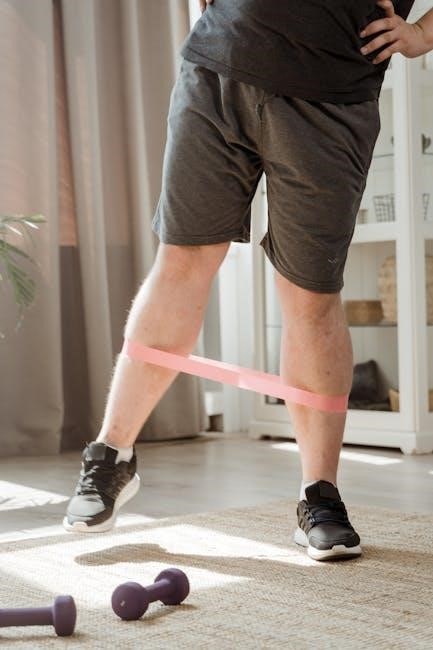
Strengthening your quadriceps is crucial for overall fitness, athletic performance, and daily activities; a PDF guide can help organize your routine.
Effective quadriceps training involves a variety of exercises, from bodyweight movements to those utilizing dumbbells or machines, for comprehensive development.
A well-structured quadriceps workout, easily accessible through a PDF, will enhance stability, power, and reduce the risk of injury during physical exertion.
Why Quadriceps Strength Matters
Quadriceps strength is fundamentally important, extending far beyond aesthetic goals; it’s the cornerstone of functional movement and athletic prowess. Strong quads directly impact your ability to walk, run, jump, and climb stairs with ease and efficiency. A quadricep strengthening exercises PDF can be your guide.
These muscles are vital for stabilizing the knee joint, protecting it from injury during high-impact activities and providing support during everyday motions. Neglecting quadriceps development can lead to imbalances, increasing the risk of strains, sprains, and even more serious knee problems.
For athletes, powerful quadriceps translate to increased speed, agility, and explosive power in sports. A targeted PDF workout plan ensures you’re maximizing your potential. Furthermore, robust quadriceps contribute to improved posture and balance, enhancing overall physical well-being and quality of life.
Anatomy of the Quadriceps
The quadriceps femoris, commonly known as the quads, isn’t a single muscle, but a group of four distinct muscles located on the front of the thigh. Understanding this anatomy is key when utilizing a quadricep strengthening exercises PDF. These muscles are the rectus femoris, vastus lateralis, vastus medialis, and vastus intermedius.
The rectus femoris is unique as it crosses both the hip and knee joints, enabling hip flexion and knee extension. The remaining three – vastus muscles – primarily focus on knee extension. Each muscle contributes uniquely to leg movement and stability.
Effective quadriceps training requires targeting all four muscles for balanced development. A comprehensive PDF guide will incorporate exercises that address each component. The quadriceps attach to the hip and knee, playing a crucial role in locomotion and force production, making their strength paramount for overall functionality.
Bodyweight Quadriceps Exercises
Bodyweight exercises are an accessible starting point for quadriceps strength, perfect for inclusion in your PDF; no equipment is needed for initial gains.
Squats: The Foundation
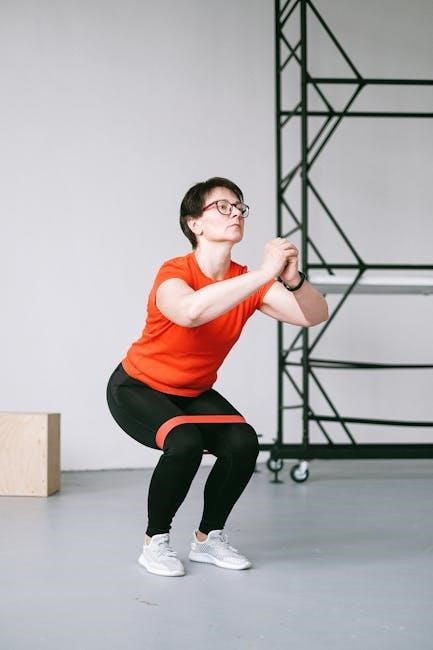
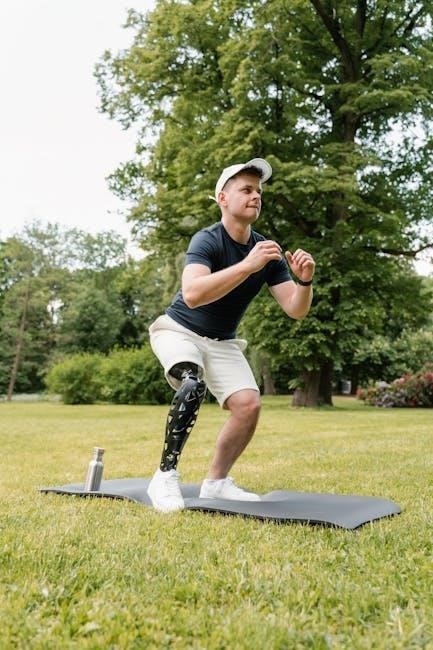
Squats are undeniably the cornerstone of any effective quadriceps strengthening program, and a vital component of your PDF workout plan. They are a compound exercise, meaning they engage multiple muscle groups simultaneously, maximizing efficiency and overall strength gains.
Proper form is paramount; begin with feet shoulder-width apart, toes slightly outward, and maintain a straight back throughout the movement. Lower your hips as if sitting into a chair, keeping your weight in your heels.
Aim for thighs parallel to the ground, or as low as your flexibility allows, before driving back up to the starting position. Variations, such as tempo squats (slowing down the eccentric phase) or pulse squats, can be added to increase intensity and challenge your muscles further. Include detailed instructions and images in your PDF to ensure correct execution.
Beginners should start with bodyweight squats, gradually increasing repetitions and sets as strength improves.
Lunges: Variations and Technique
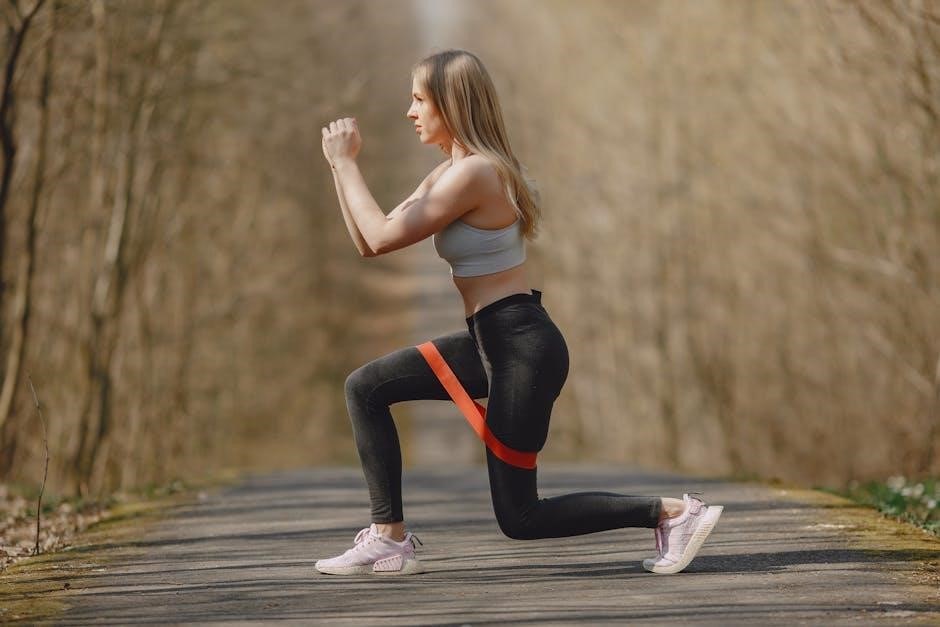
Lunges are another fundamental exercise for quadriceps development, offering a fantastic addition to your PDF’s exercise library. Unlike squats, lunges are a unilateral exercise, meaning they work one leg at a time, improving balance and addressing muscle imbalances.
Start by stepping forward with one leg, lowering your body until both knees are bent at approximately 90 degrees. Ensure your front knee stays aligned over your ankle and doesn’t extend past your toes. Push off with your front foot to return to the starting position.
Variations include forward lunges, reverse lunges, walking lunges, and lateral lunges, each targeting the quads from slightly different angles. Your PDF should illustrate each variation with clear instructions and visual aids. Consider adding progressions, like holding dumbbells, to increase the challenge as strength increases.
Focus on controlled movements and maintaining a stable core throughout each lunge.
Wall Sits: Isometric Strength
Wall sits are an excellent, low-impact exercise for building quadriceps strength, perfectly suited for inclusion in your PDF guide, especially for beginners or those recovering from injury. This isometric exercise focuses on holding a static position, engaging the quads without joint movement.
To perform a wall sit, stand with your back flat against a wall, feet shoulder-width apart, and slide down until your thighs are parallel to the floor, mimicking a seated position. Maintain a 90-degree angle at your knees.
Hold this position for as long as possible, aiming for 30-60 seconds, and repeat several times. Your PDF should emphasize maintaining proper form – back flat against the wall, core engaged, and knees aligned over ankles.
Wall sits are fantastic for building endurance and strengthening the quads without placing excessive stress on the joints, making them a versatile addition to any fitness level.
Step-Ups: Utilizing Elevated Surfaces
Step-ups are a dynamic quadriceps exercise ideal for your PDF, effectively targeting the quads, glutes, and hamstrings while improving functional strength and balance. This exercise utilizes an elevated surface, such as a bench or sturdy box.
To perform a step-up, stand facing the elevated surface, place one foot firmly on top, and drive through that heel to lift your body up, extending your leg. Bring the other foot up to meet it, then slowly lower yourself back down.
Your PDF should highlight the importance of maintaining good form: keeping your core engaged, back straight, and knee tracking over your ankle during the ascent and descent. Alternate legs with each repetition.
Adjusting the height of the surface increases the intensity, making step-ups scalable for all fitness levels. Include variations in your PDF, like adding dumbbells for increased resistance.
Quadriceps Exercises with Dumbbells
Dumbbells amplify quadriceps workouts, offering progressive overload for your PDF; they enhance muscle growth and strength, building a robust lower body.
Integrating dumbbell exercises into your PDF routine provides versatility and challenges muscles in new ways, maximizing training effectiveness.
Proper form and controlled movements are essential when using dumbbells, ensuring safety and optimal results as detailed in your PDF guide.
Dumbbell Squats: Adding Resistance
Dumbbell squats are a fantastic progression from bodyweight squats, significantly increasing the challenge to your quadriceps and overall lower body strength, perfect for inclusion in your quadriceps strengthening PDF.
To perform dumbbell squats, hold a dumbbell in each hand, positioned at your sides or resting on your shoulders, maintaining an upright posture throughout the movement. Ensure your core is engaged for stability.
As you descend into the squat, keep your back straight, chest up, and knees tracking in line with your toes. Lower yourself until your thighs are parallel to the ground, or as low as your flexibility allows.
Drive through your heels to return to the starting position, squeezing your quadriceps at the top of the movement. Focus on controlled movements, avoiding rushing through the exercise.
Your PDF should detail starting with lighter weights and gradually increasing the load as your strength improves. Proper form is paramount to prevent injuries and maximize effectiveness.
Dumbbell Lunges: Increased Challenge
Dumbbell lunges elevate the intensity of traditional lunges, providing a greater stimulus to your quadriceps, hamstrings, and glutes – a valuable addition to any quadriceps strengthening PDF. Holding dumbbells increases the resistance, demanding more from your muscles.
Begin by holding a dumbbell in each hand, maintaining good posture. Step forward with one leg, lowering your body until both knees are bent at approximately 90-degree angles.
Ensure your front knee stays aligned over your ankle and doesn’t extend past your toes. Your back knee should hover just above the ground, maintaining a controlled descent.
Push off with your front foot to return to the starting position, and repeat on the other side. Alternate legs with each lunge, or complete all repetitions on one leg before switching.
Your PDF should emphasize maintaining balance and controlled movements. Start with lighter weights and focus on proper form before increasing the load for optimal results and injury prevention.
Bulgarian Split Squats with Dumbbells
Bulgarian split squats with dumbbells represent a highly effective, yet challenging, exercise for isolating and strengthening the quadriceps, making them a standout inclusion in a comprehensive quadriceps strengthening PDF. This exercise significantly increases the demand on each leg individually.
Position your upper back against a bench, extending one leg back and resting the top of your foot on the bench. Hold a dumbbell in each hand at your sides.
Lower your body by bending your front knee, keeping your torso upright and your front knee tracking over your ankle. Descend until your front thigh is parallel to the ground.
Drive through your front heel to return to the starting position, maintaining control throughout the movement. Complete all repetitions on one leg before switching to the other.
A detailed PDF should highlight the importance of core engagement and controlled descent. Start with lighter dumbbells and prioritize form to maximize benefits and minimize risk.
Advanced Quadriceps Exercises
Advanced exercises, detailed in a quadricep strengthening PDF, build significant strength and muscle mass; leg presses and hack squats are prime examples.
These movements demand greater stability and control, pushing your quadriceps to their limits for optimal development and performance gains.
Proper form is paramount when incorporating these challenging exercises into your routine, ensuring safety and maximizing results.
Leg Press: Machine-Based Strength
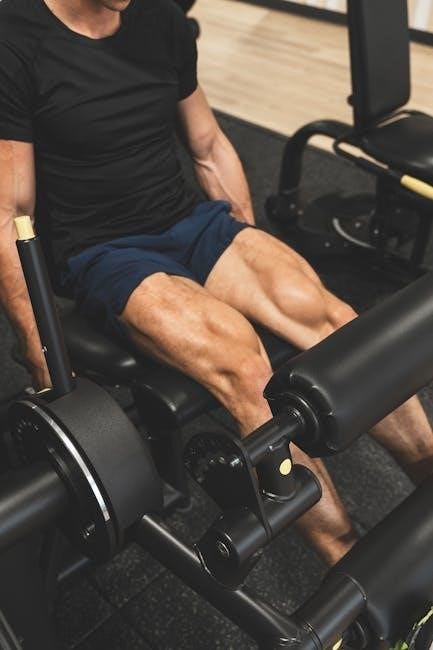
The leg press is a fantastic compound exercise, often featured prominently in a comprehensive quadricep strengthening PDF, allowing for substantial load and targeted muscle activation.
Unlike squats, the leg press provides back support, making it a suitable option for individuals with lower back concerns or those seeking to isolate the quadriceps more effectively.
Proper form is crucial: maintain a slight bend in your knees throughout the movement, and avoid locking them at the top. Feet should be shoulder-width apart, positioned appropriately on the platform to emphasize quad engagement.
Experiment with foot placement – higher placement targets the glutes and hamstrings more, while lower placement emphasizes the quadriceps.
A PDF guide should detail varying rep ranges for different goals: lower reps (6-8) for strength, moderate reps (8-12) for hypertrophy, and higher reps (12-15+) for endurance. Always prioritize controlled movements over lifting maximal weight.
Remember to adjust the seat to ensure a comfortable range of motion and prevent injury.
Hack Squats: Targeted Quad Development
Hack squats, a staple in many quadricep-focused workout PDFs, offer a unique angle for intense quad isolation and development, differing significantly from traditional squats.
The machine’s design minimizes stress on the lower back, making it a viable option for individuals seeking a quad-dominant exercise with reduced spinal load.
Proper technique involves maintaining a controlled descent, keeping your back firmly against the pad, and pushing through your heels to activate the quads effectively.
Avoid rounding your back or lifting your heels during the movement, as this can compromise form and increase the risk of injury. A PDF should illustrate correct posture.
Varying rep ranges – 8-12 for hypertrophy, 6-8 for strength, and 12-15+ for endurance – can be incorporated into your routine, as detailed in a well-designed PDF guide.
Adjust the weight incrementally and prioritize controlled movements to maximize quad engagement and minimize the risk of strain.
Quadriceps Exercises for Rehabilitation
Rehabilitation focuses on gentle exercises, like straight leg raises, to rebuild quadriceps strength post-injury; a PDF guides progressive recovery.
Opposing muscle work, such as hamstring curls, balances strength and supports joint stability, as outlined in a comprehensive PDF.
Straight Leg Raises: Early Stage Recovery
Straight leg raises are foundational in early quadriceps rehabilitation, focusing on activating the muscle without stressing the joint. This exercise is ideal for individuals recovering from knee injuries or surgery, as detailed in a quadricep strengthening exercises PDF.
Technique: Lie flat on your back with one leg bent and the other extended straight. Tighten the quadriceps of the straight leg, lifting it approximately 6-12 inches off the ground. Maintain a controlled movement, avoiding any locking of the knee. Slowly lower the leg back down.
Progression: Begin with 10-15 repetitions, gradually increasing the number of sets and reps as strength improves. Ankle weights can be added for increased resistance, but only when you can perform the exercise with proper form. A PDF guide will illustrate proper form and progression.
Important Note: If you experience any pain, stop the exercise immediately and consult with a physical therapist. This exercise is a building block, preparing the quadriceps for more challenging movements.
Hamstring Curls (as opposing muscle work)
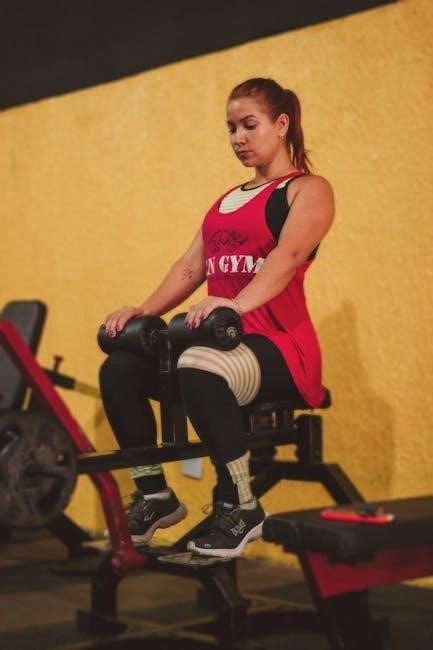
While focusing on quadriceps, incorporating hamstring curls is vital for balanced leg strength and injury prevention, a concept often highlighted in a comprehensive quadricep strengthening exercises PDF. The hamstrings act as antagonists to the quadriceps, ensuring proper joint mechanics.
Execution: Using a machine, lie face down and curl your heels towards your glutes, contracting the hamstrings. Maintain a controlled tempo throughout the movement, avoiding jerky motions. Focus on squeezing the hamstrings at the peak of the contraction.
Benefits: Strengthening the hamstrings helps stabilize the knee joint, counteracting the forces generated by the quadriceps. A PDF workout plan should include 3-4 sets of 10-15 repetitions. This balanced approach minimizes muscle imbalances.
Considerations: Proper form is crucial to avoid injury. If using resistance bands, ensure they are securely anchored. A well-rounded quadriceps program acknowledges the importance of opposing muscle groups.

Creating a Quadriceps Workout PDF
Designing a quadriceps workout PDF allows for organized training, tracking progress, and easy access to exercises; it’s a convenient fitness resource.
Include exercise descriptions, sets, reps, and rest times for clarity, ensuring a user-friendly and effective PDF guide for quadriceps strength.
Structuring Your PDF

Organizing your quadriceps workout PDF requires a logical flow for optimal user experience. Begin with a clear title page and a brief introduction outlining the benefits of quadriceps strengthening and the PDF’s purpose.
Categorize exercises by difficulty – bodyweight, dumbbell, advanced – allowing users to progress safely. Each exercise should have its own dedicated section, including a concise description of the proper form, a visual aid (image or illustration), the recommended number of sets and repetitions, and suggested rest periods.
Consider adding a warm-up and cool-down section with specific stretches targeting the quadriceps and surrounding muscle groups. A final section could include safety precautions and modifications for individuals with limitations. Use headings, bullet points, and consistent formatting to enhance readability and create a professional-looking PDF.
Finally, a printable checklist for tracking workouts can boost engagement and motivation.
Important Considerations for PDF Design
Designing an effective quadriceps exercise PDF necessitates prioritizing clarity and visual appeal. Choose a legible font size and style, ensuring comfortable reading on various devices. Utilize high-quality images or illustrations demonstrating correct exercise form; these are crucial for preventing injuries.
Employ consistent color schemes and headings to maintain a professional aesthetic and guide the user through the content. Optimize the PDF for file size to facilitate easy downloading and sharing, especially for mobile users.
Ensure the PDF is accessible – consider adding alt text to images for screen readers. Interactive elements, like clickable links to exercise videos, can enhance the user experience. Finally, test the PDF on different platforms to confirm proper formatting and functionality before distribution.
A well-designed PDF encourages consistent use and maximizes the benefits of the workout.
Safety and Precautions
Prioritize proper form during all quadriceps exercises; a PDF should emphasize this. Warm-up adequately and cool-down post-workout to prevent injuries and maximize gains.
Warm-up and Cool-down
Before initiating any quadriceps strengthening exercises – detailed within this PDF – a dynamic warm-up is essential. This prepares your muscles and joints for the workload, significantly reducing injury risk. Include exercises like leg swings (forward, backward, and lateral), high knees, butt kicks, and walking lunges.
A proper warm-up increases blood flow to the quadriceps, enhancing muscle elasticity and nerve conduction. Spend approximately 5-10 minutes on this phase. Following your workout, a cool-down is equally vital; Static stretches, holding each stretch for 20-30 seconds, help improve flexibility and reduce muscle soreness.
Focus on stretching your quadriceps, hamstrings, and calves. Examples include quad stretches (pulling your heel towards your glutes), hamstring stretches (touching your toes), and calf stretches (leaning against a wall). A comprehensive PDF guide should visually demonstrate these stretches for correct execution, ensuring a safe and effective recovery process.
Strong quads = happy knees! Download our FREE PDF guide with effective quad strengthening exercises. Perfect for athletes, rehab, or just feeling great. Get yours now!